Thursday, March 14, 2013

Boosterthon Time!

It's hard to believe that the chefs at Culinary Court like ANYTHING more than they like reading, writing, math, science, and social studies......but they actually do!!!  What could they possibly enjoy more than learning with their very own Top Chefs at Culinary Court???


BOOSTERTHON!!!

Our students are working hard to gather pledges for every lap they will run next Wednesday, and the countdown is on!!!  In addition to helping your child phone family and friends this week, you can support us all by planning to come cheer on our teams of runners as they race around the Boosterthon Speedway -- not once, not twice, but UP TO 35 TIMES!!!

So mark your calendars, families.  Bring your banners and your bells.  Pack your signs and your smiles.  Plan to be energized and entertained as you watch your fourth graders burn rubber on the Highway USA Boosterthon Speedway!  

We promise, you won't want to miss it!!!

Pssst!!!  Writers, did you catch the alliteration in this blog post?  Where is it?  Just for fun, try writing your own alliterative sentence about Boosterthon!  

Thursday, March 7, 2013

Recipe Secrets!

Pssst!!! 

Here's a little homework hint from the ELA kitchen:

Did you know that, when referring to the infinite resources we access with our web browsers, the word "Internet" is a proper noun?  Think of the Internet as one big place people visit to get answers, connect with people, share information, and virtually explore the world.  We already know that specific places, such as Chets Creek Elementary, St. John's Town Center, or Walt Disney World, are all proper nouns.

In contrast, the word "website" is NOT a proper noun.  Why?  Just like the word "school" or "mall", this word could be referring to many different specific places, and we don't know exactly which one.  An exact website, like Culinary Court, should be capitalized, showing that it is a special place and therefore a proper noun.

Keep this hint in mind when you're completing your study guides this week, chefs!

To read more about tricky proper nouns, check out Grammar Girl's post.  

Wednesday, March 6, 2013

Nonfiction Text Structures

As we continue in our journey exploring nonfiction, we dig beneath the features of the text (captions, photographs, text boxes, maps, charts, diagrams, labels, glossaries, indexes, etc.) and begin to uncover the structure of the piece. Even though all nonfiction pieces are written to inform us about a topic, some authors decide to build the text in a certain way, based on exactly what they are trying to teach us. Take for example our sample paragraphs in our foldable, about crocodiles. An author could teach us about crocodiles by: describing them, sequencing their mating process in time order, cause and effect of relationships between crocodiles and crocodile birds, problems and solutions for the hunting of crocodiles, and/or comparing and contrasting crocodiles to other classifications of crocodiles like caimans and gavials. These are known as the five different nonfiction text structures.


We made foldables to help us learn the differences between each structure!

Sometimes, an author may choose to use more than ONE text structure in their piece. In a book about Wildfires, the author may teach you about them by giving you a description of what they are in the first section. Then, they may show you the chronological order of events that happens during a wildfire. In another section, they might give you all of the effects of a wildfire. The way we decide which structure an author is using is by looking for signal words. Next, we ask ourselves, "How did the author teach me about this topic?" and "How did they build their ideas?".


These readers are highlighting signal words they find in their article. With the help of their
foldable and graphic organizers, they can determine the structure of the text.


Writers, how could this information we have learned about text structure help us when writing an informational piece?
Readers, why is it important to uncover the structure of a text? Why does it matter?

Saturday, March 2, 2013

Justifying Area

Our recent emphasis in the Math Workshop has been with estimating and justifying the area of irregular shapes.

One tool that we have used to justify the area formulas for rectangles and right triangles has been the Geoboard.

Formula for Rectangles (Area = Base x Height)
Formula for Triangles (Area = 1/2 Base x Height)


Consider the irregular polygon shown on the Geoboard template below.

What is the area of this pentagon?  During Math Workshop, we have approached the task of finding solutions to problems similar to this by decomposing the figure into smaller rectangles and right triangles so that we can use the area formulas for the smaller parts and then put those smaller totals together to find a justified total area. 
The green rectangular area in this pentagon has a base of 3 units and a height of 2 units, so the area of this rectangle is 6 square units.   Area of a Rectangle  = Base x Height, so 6 = 3 x 2.
The right scalene triangle (red) shown on the grid is exactly HALF of 2 square units (the dotted lines are shown to illustrate this idea). 
Therefore, the area of the triangle is 1 square unit.
Area of a Triangle = 1/2 Base x Height

The base of the triangle is 1 unit and the height of the triangle is 2 units.
(1 x 2) ÷ 2 = 1

A right scalene triangle is exactly half of a rectangle


The right isosceles triangle (blue) shown on the grid is exactly HALF of 1 square unit (the dotted lines are shown to illustrate this idea). 
Therefore, the area of this triangle is 1/2 square unit.
Again, Area of a Triangle = 1/2 Base x Height

The base of this triangle is 1 unit and the height of the triangle is 1 unit.
(1 x 1) ÷ 2 = 1/2

A right isosceles triangle is exactly half of a square.


All decomposed parts are then combined to identify the total area of the figure. 


The area of the pentagon is 7 1/2 square units!!


Students, you can have fun with virtual Geoboards by clicking the link below, which will take you to the Virtual Library of Math Manipulatives. (A parent may have to install Java in order for you to utilize this site.)

Click Here: VIRTUAL GEOBOARD FUN


Also, if you would like to practice with transformations, you can click the links below for some more virtual fun! 


Virtual TRANSLATIONS (Slides)  


If you utilize these online resources, leave a comment to let your teachers know so you can earn some extra Behavior Bucks!

Friday, March 1, 2013

Author's Purpose: Bringing the FAT-P to Readers' Workshop

We all know that the Super RUPR has a trusty sidekick, the FAT-P.  Culinary Court writers came to rely on these superheros when preparing to respond to a prompt.  But how can Culinary Court readers use the FAT-P to help them as they're reading?

First, let's remember what FAT-P stands for:

Format
Audience
Topic
Purpose


As writers, we've learned to always keep our audience in mind.  We should be aware of them and write to help them understand our main ideas and purpose for writing.  As readers, we can remember how we planned our writing specifically to support our main ideas and make our meaning clear to our readers.  And, if we did this as writers, wouldn't it seem logical that professional writers might do this to help us?

We know authors write for a variety of purposes. We know three main purposes are to explain (teach), entertain, and persuade.  Often the format an author chooses can help us determine the purpose, but it's not always that simple.  Being the sophisticated readers we are, we know that writing purposes often overlap.  One piece of writing might be written for more than one of these purposes.  For instance, in the poem "Dreams" by Langston Hughes, we know that Mr. Hughes is writing both to persuade and entertain.

Dreams
Hold fast to dreams
For if dreams die
Life is a broken-winged bird
That cannot fly.
Hold fast to dreams
For when dreams go
Life is a barren field
Frozen with snow.
~Langston Hughes

As we discussed in class, the main purpose of this poem is to persuade readers, but Mr. Hughes also wanted his reader to be entertained, which is why he chose the format of a poem.

Considering the format and genre of a piece of writing can be very revealing when discovering an author's purpose, but there are exceptions.  For instance, we've read many pieces of text recently about slavery and the Underground Railroad.  The Storyworks article, "From Slavery to Freedom", is jam-packed with facts and details, teaching its readers all about Harriet Tubman and her accomplishments on the Underground Railroad.  It isn't surprising that the main purpose of this article is to teach or explain, as articles are most commonly linked with informing.  However, any story that is also based on true facts, such as Henry's Freedom Box, is also written to teach.  Authors of true stories, or narrative nonfiction, considered their audience and topic when they determined their format, selecting a format that would allow them to teach while they were also entertaining.  As another example, folk tales and fables, though they are considered a genre of fiction today, were originally told to teach or explain.  Because newspapers, magazines, textbooks and the internet did not exist when these stories were first told, elders orally told tales, or stories, for the purpose of explaining parts of the natural world, such as why the tortoise has a "cracked" shell, and teaching life lessons, such as the importance of telling the truth.


Understanding the main purpose is just the first step to determining the complete author's purpose.  An author's purpose also includes the main idea of the piece.  Take, for example, this blog post.  Considering first the format, a blog post, we begin to understand that this article is written to inform.  But readers will miss the boat if that's all they know.  What are the important main ideas of this blog post?  What lessons am I, the writer, trying to teach my audience?  Combining the main idea(s) of a text with the purpose will help a reader fully comprehend what they've read.

In the coming weeks, readers will analyze a variety of nonfiction pieces to determine how the author organized their writing to support their purpose.  We will use signal words and identify important ideas within each text to determine what text structure, or organization method, each writer used.  Then, we'll use this understanding to help us create a complete author's purpose statement.

***Psssst!  Reader-writers, did you spy an idiom in this post?  Where is it?  What does it mean?***

Wednesday, February 27, 2013

The Need for Speed

Running the CCE Track

Today all of the Culinary Court kiddos ran their fastest as they were timed running a 58 meter dash and a trip around the CCE track. Mr. Pinchot and Mrs. Phillips recorded each students' individual running times so that we can take this DATA and determine how fast each child can run (from meters per second to miles per hour averages). Students will practice calculating speed (distance divided by time) and then correlate these times to speeds of several common animals (cheetah, etc.). We will also compare this data with information we collected in another previous lab on rolling marbles down various sized ramps. Correlating these experiences to our text (Ch. 6, Lesson 2) will be a piece of cake.
In addition, on our bus ride to MOSH, we experienced speed, acceleration, and velocity first-hand, which made for some interesting conversations both during the bus ride and after we returned to school!

Parents, be sure to ask your child about the above-listed terms while you are traveling together in your car. You can also ask your child about frictionreference points and relative motion. Your child should be able to explain what all of these terms mean. :-)

Happy Sciencing!!

Sunday, February 24, 2013

Multi-Digit Multiplication Makes a Transition

Our work with multi-digit multiplication has certainly made progress over the last few months. Here is a review of the development of this learning trajectory:

Multiplication Cluster

This strategy of decomposing one of the factors has empowered students to learn how to solve problems using mental mathematics. It has reinforced the concept of multiplication in that one factor represents the size of groups while the other factor represents the number of groups.

Open Array Model 

This model has been fantastic as we have made sense of multiplication with larger factors because it has helped us not lose sight of the value of each factor and it has enabled us to decompose BOTH factors and keep track of finding all of the needed partial products.

Transition to the Traditional Algorithm

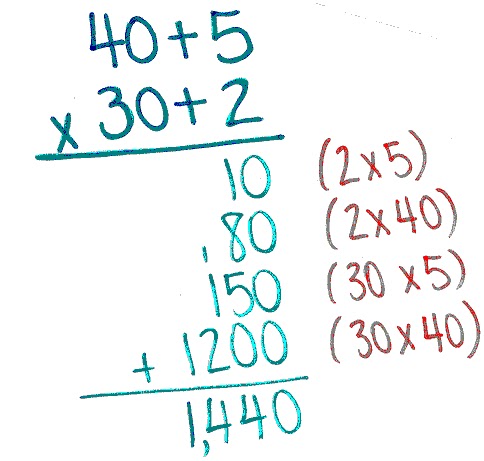
Recent efforts in math have been to use this model (which also decomposes both factors like the open array does) to understand how and why the traditional algorithm works. With this model, we practice multiplying in the same order that is used with the algorithm, but without the succinct regrouping. *Notice that the SAME four smaller problems solved here match the four smaller problems in the open array model above. These SAME four smaller problems are also calculated in our heads when using the traditional algorithm (below) too!

Traditional Algorithm

Aah......our final destination. Now that we have explored the concept of multiplication so deeply, we feel our students are ready to truly understand how and why this succinct strategy works. They must be able to explain it, though, if they are to use it as a primary strategy in class.
Can you see how all of these strategies are related? :-)


Deep conceptual understanding is realized when one can solve a problem in multiple ways and make connections between strategies and models in how they are related and why they work. Mathematical conversations have never been more fun!